Underwriting Readiness Is Increasingly Tied to Proof, Not Promises
Published by
Tehama Wireless
on
For billing partners, underwriting pressure doesn’t arrive as a theoretical risk discussion. It arrives as a documentation request: “Show what happened.” “Explain the charges.” “Confirm the system was functioning.” In 2025, insurers, lenders, and capital partners became more explicit about the evidence they expect to see. Heading into 2026, that standard is tightening.
What Insurers and Lenders Are Asking for in Multifamily
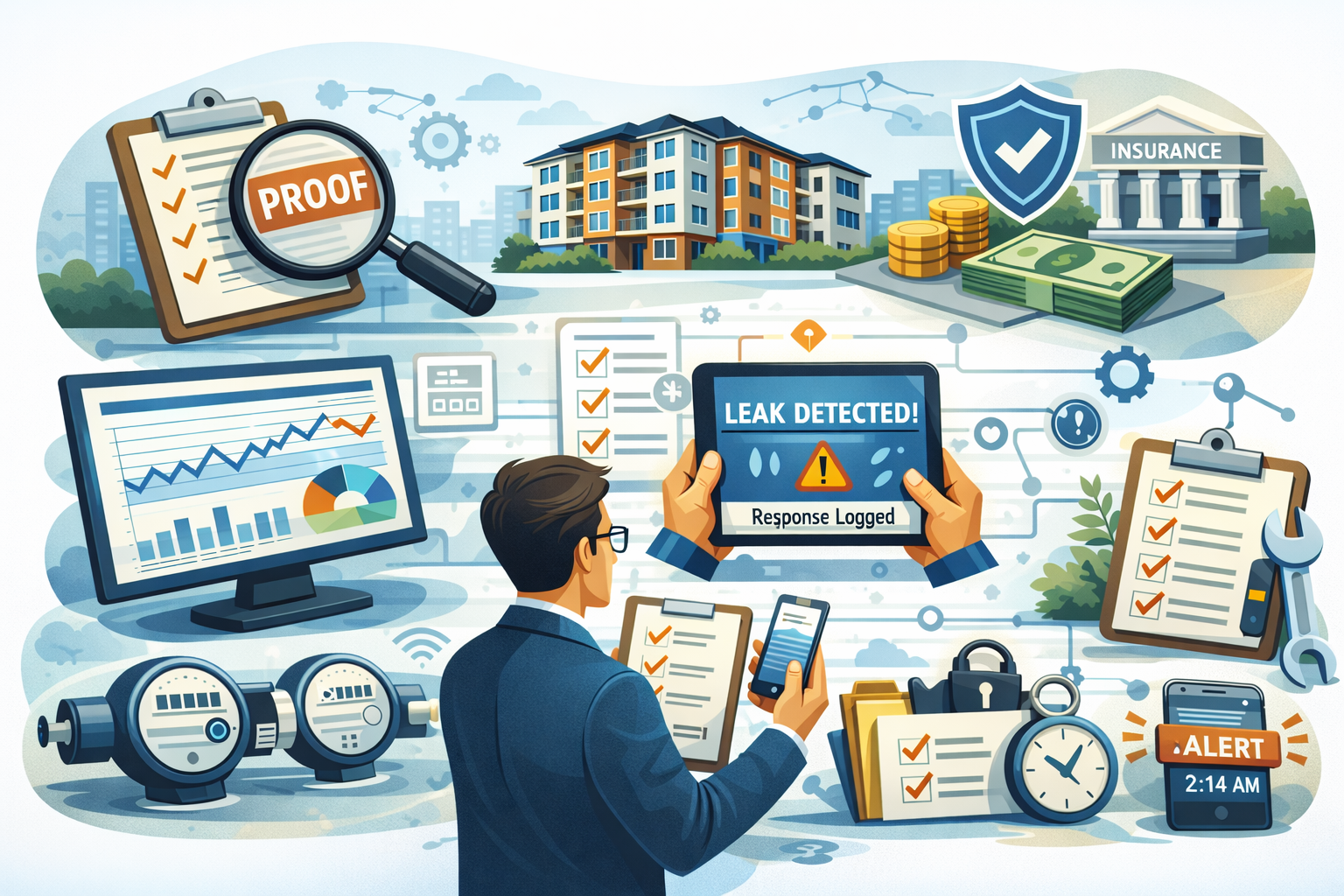
Across multifamily portfolios, reviewers are placing more weight on operational proof than on installation claims. Instead of accepting statements like “we have leak detection” or “we track usage,” they increasingly want to see coverage clarity, data continuity, and a documented response trail when anomalies occur.
This shift isn’t driven by new laws so much as underwriting criteria, renewal terms, and sustainability or performance reporting expectations. In practice, it shows up as requests for automated detection in higher-risk contexts, remote access to utility usage data, confirmation that alerts are logged and acted on, and proof that systems are maintained and producing reliable reads over time. Accessible, non-black-box data is often preferred because it reduces friction when documentation is needed quickly.
Where Proof Requests Originate
Much of this pressure doesn’t surface as a direct interaction between underwriters and billing partners. It surfaces as reporting and documentation obligations that owners and asset teams are required to satisfy, often on a recurring basis, which pushes them back into their utility usage records and billing history.
In sustainability-linked financing and portfolio reporting, owners may be required to submit ongoing energy and water performance metrics over time, increasing the premium on consistent, comparable data. On the insurance side, loss-prevention practices increasingly rely on connected monitoring and documented incident response, reinforcing the expectation that risk controls can be evidenced rather than assumed.
Billing partners may never speak to insurers or lenders directly. But when proof is requested, the record has to come from somewhere—and billing and usage history are often the fastest way to produce it.
Why Utility Usage Records Matter in Risk Reviews
When documentation is requested, utility usage records are frequently the most complete, time-ordered source of evidence available. They are resident-facing, tied directly to charges, and reflect how a program actually operates over time.
As a result, usage tracking programs are increasingly evaluated not just as a way to allocate costs, but as an evidence trail. The most useful records include complete interval history, clear handling of exceptions, documented corrections, and transparent explanations for how charges were calculated.
Where Metering Programs Break Down Under Scrutiny
Under review, a few failure patterns reliably increase questions, rework, and credibility risk. These include missing reads paired with heavy estimation, manual adjustments that are difficult to explain later, inconsistent statements that trigger disputes, and alert timelines that can’t be tied back to documented response.
When these gaps exist, billing teams are forced into reconstruction mode; piecing together timelines and justifying outcomes after the fact. That scramble often happens precisely when speed and clarity matter most, turning routine reviews into high-friction events.
How to Build Audit-Ready Utility Documentation
Billing partners don’t need to become underwriters, but they do need programs designed for defensibility. The strongest programs share a few characteristics: defined rules for estimates and corrections that are applied consistently, auditable change logs so adjustments aren’t “mystery edits,” clean data handoffs with standardized naming, and documentation that can be produced quickly without last-minute reconstruction.
These practices reduce disputes and rework, shorten response cycles, and make it far easier to stand behind outcomes when questions arise.
What Billing Partners Should Prioritize in 2026
As expectations tighten, the differentiators won’t be those who have the most devices installed. It will be the ones who can demonstrate continuity, explainability, and repeatable responses.
In practical terms, programs that are bill-ready are also underwriting-ready, and billing partners play a central role in making that defensibility repeatable at scale.
Engage with Us
Have Questions? Contact us for expert advice.
Join the Conversation: Follow us on LinkedIn.
Thank you for visiting our site. We look forward to helping you optimize your utility management!